
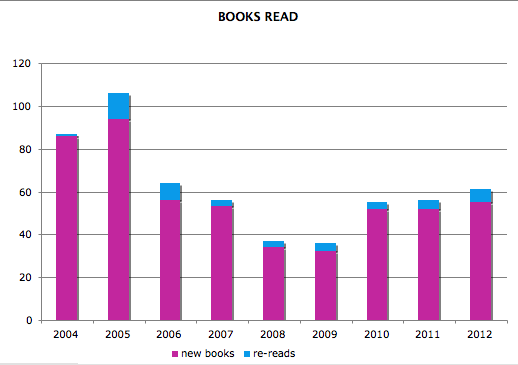
This is the most books I’ve read in a single year since 2006. The fact that it rained all the time, so I was not cutting my commute short in order to walk, is the main driver of this trend.
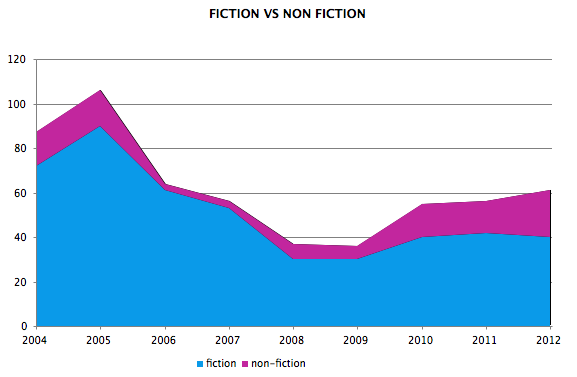
For the first time since 2008, the amount of fiction I have read has declined year on year. This is the first time since records began that this has not been accompanied by an overall decline in the number of books read. I’m not sure I can pinpoint any single important factor in this; I read some really easy non-fiction books, such as Tina Fey’s autobiography and Caitlin Moran’s book, but there was no real theme to this year’s non-fiction.
Last year’s big project was Godel, Escher, Bach, which was enormously hard work for the same reason it was a joy to read. It’s great fun, but also exhausting, to spend time with someone who thinks that in order to really talk about something you need to make sure your audience knows enough about all of science and art and music and human history. The book itself started as a letter, then he realised it was maybe a pamphlet, then a book, then he added the Escher stuff towards the end, so scope creep is in itself a part of the project. I was glad I read this at the start of the year, as it gave me a lot to think about in the rest of my reading – If On A Winter’s Night A Traveller was particularly nice to read after GEB.
The two best authors I read last year have been Alan Warner and George Saunders. What these two have in common, and there’s not a lot, is a sense of non-place; conference halls, airports, service stations, waiting.
I’ve read Morven Callar by Warner, but it stuck with me a lot less than The Sopranos and The Stars In The Bright Sky. These two lovely and spiky books are about a group of girl friends from a small town in Scotland, in their fifth year of school in The Sopranos and three years later in The Stars In The Bright Sky. They’re both beautiful portraits of group dynamics and boredom and friendship. I was also naturally predisposed to like the Scottishisms, of which there were many.
George Saunders writes short stories about hopelessness in America that fall somewhere on the spectrum between “bittersweet” and “desperately sad”. Most of these stories are also extremely funny, and in their own way gentle and kind; you don’t feel like he’s giving his characters hard lives, because you really believe in the external forces that are making their lives hard. I started with Pastoralia, and I’d recommend that you start there too.
The first book I read was Craig Taylor’s Londoners, a brilliant book of interviews about London. There was very little authorial voice – just people talking about their lives in London and their experience of living there has been. I would highly recommend this book to anyone who likes London, mundanity or both.
The last book I read this year was The Bridges Of Madison County. I’ve not been this disappointed by a cultural artefact since Titanic! I was expecting this to be an extremely moving love story that I would be emotionally affected by against the wishes of my better self. It was a lot more… just like a bored housewife having an affair with a guy who talks in paragraphs about being one of the “last cowboys”. Maybe it’s that I don’t “get” the cowboy trope, maybe it’s that I don’t believe in love at first sight, but my better self triumphed throughout my reading of this book.
Two books that I did not expect to be massively depressing, but they both were, were Seeing Things by Oliver Postgate and One Day. They both played on the theme that getting old – or even a bit older – is really horrible, and you’re not necessarily going to be happy with the choices you’ve made or the way the world at large turned out. I was probably expecting both books to be cosier than they were, so the not at all happy ending of both of them was like a punch in the gut I hadn’t braced for.
Other things; I read two books last year in which someone left their mother after their father’s death, and returned two days later to find that she had committed suicide. One of these books was fiction, the other non-fiction, and the former was written first so it’s close to impossible that one influenced the other.
I also read two biographies of authors, I Am Alive And You Are Dead about Philip K Dick (he had five wives! he wrote fourteen books in six years!) and the other was Some Sort Of Epic Grandeur, Matthew Bruccoli’s highly detailed bio of F Scott Fitzgerald. I enjoyed both of them, especially the one about Dick as I knew a lot less about his life than I do about Fitzgerald’s.
Last year’s aims were:
Join the library! This is not a direct reading aim but I read so well when I was last a member of a library
I did this! I’ve not got anything out of the library yet, however. I may start tomorrow.
Read Gödel, Escher, Bach and King, Queen, Knave, the latter on Alex’s recommendation
I did both of these. King, Queen, Knave is indeed great, although I also read The Gift by Nabokov and did not get on with it at all
Look Homeward, Angel – I got some Maxwell Perkins letters for Christmas, know basically nothing of Thomas Wolfe, and think I’d get more out of them if I knew more than nothing.
I read the Wolfe but not the Perkins letters! I’ll do that this year.
This year I have one aim, and it is to read the entire Bible. In January last year I had the idle thought that there’s probably an app that helps you read the entire Bible in a year, then that evening went to a family do where my dad started a conversation with “Look at this great app, I’m reading the entire Bible in a year”. So I took that as a sign that I should do that this year. I’m using this plan. If you would like to join me in this for any reason, I’d be totally delighted – it’s a big project and I would enjoy undertaking it with friends.